


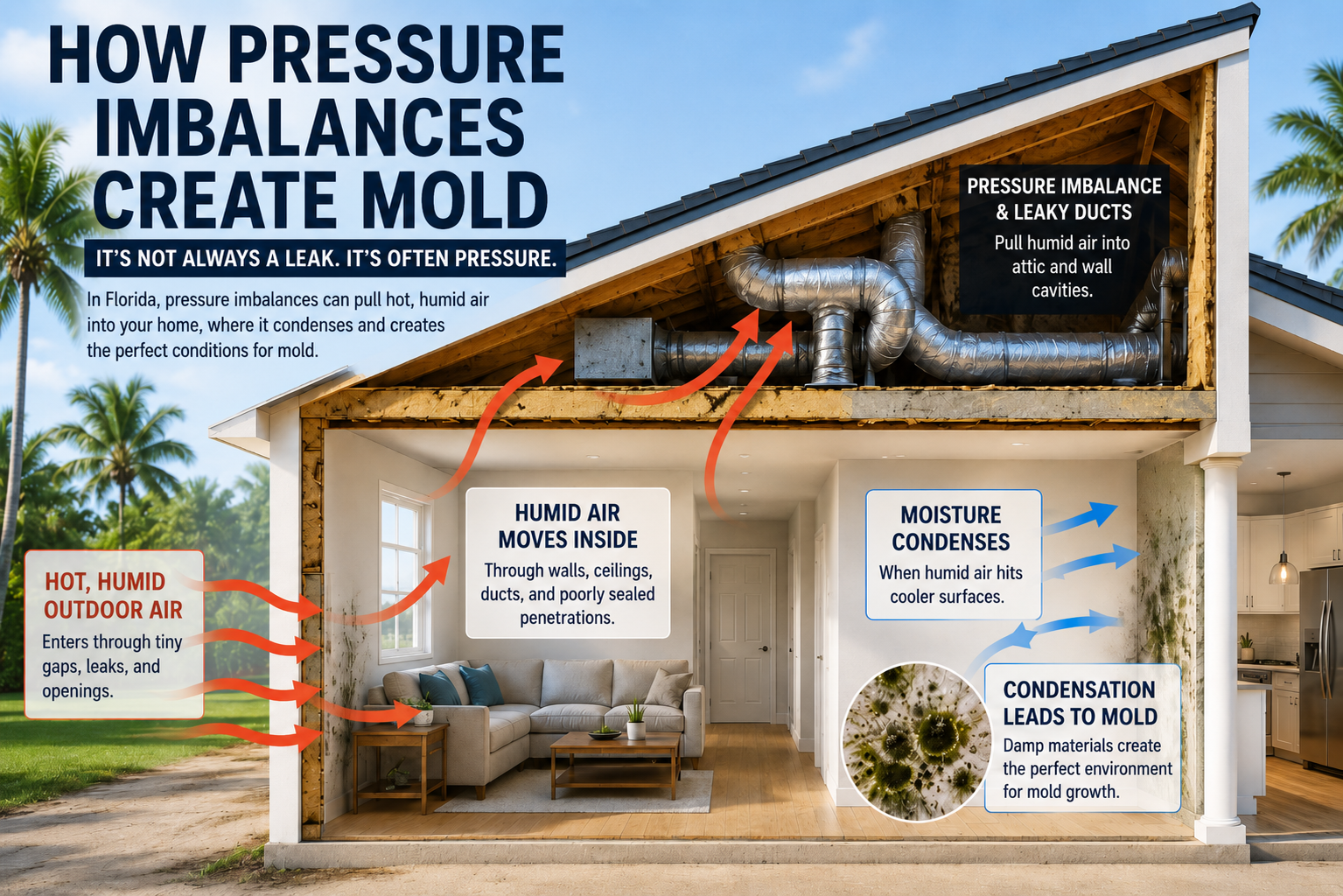
When most Florida homeowners think about mold, they picture a roof leak, a burst pipe, or a bathroom that never quite dries out. Those are real causes, of course. But one of the biggest contributors to mold growth in a Florida home is something most people never see: air pressure.
Your home isn’t just a collection of rooms. It’s a building system. The HVAC system, ductwork, attic, walls, doors, exhaust fans, and outdoor climate all interact with each other. When that system is out of balance, air moves in ways it shouldn’t. And in Florida, moving air often means moving moisture.
That’s why mold isn’t always a simple “where’s the leak?” problem. Sometimes, the better question is: Why is this building pulling humid air where it doesn’t belong?
At LAQ Environmental Health and Safety, we help homeowners understand what’s actually happening inside their home, not just whether mold is present. Because if you only treat the mold without correcting the moisture source, the problem can come back.
Mold Growth Isn’t Always Caused by a Leak
Leaks are easy to understand. Water enters the home, building materials get wet, and mold can grow if the moisture isn’t corrected quickly. But many Florida mold problems develop without an obvious leak.
Instead, they begin with elevated humidity, hidden condensation, or moisture being pulled into wall cavities, ceiling spaces, closets, or conditioned living areas.
In many cases, this happens because of one or more building performance issues:
- An oversized HVAC system that cools too quickly without removing enough humidity
- An undersized or poorly performing HVAC system that can’t keep up with moisture load
- Leaky ductwork in an attic, garage, or other unconditioned space
- Poor return-air design that creates room-to-room pressure differences
- Closed bedroom doors without proper transfer air pathways
- Exhaust fans that depressurize the home
- Poor air sealing around ceiling penetrations, walls, chases, and attic connections
- Building cavities connected to humid outdoor or attic air
None of these looks like a dramatic water event. But over time, they can create the right conditions for condensation, damp materials, musty odors, and mold growth.
Why Pressure Relationships Matter in Florida Homes
Buildings follow the laws of physics. Air moves from areas of higher pressure to areas of lower pressure. When air moves, moisture can move with it.
In Florida, outdoor air is often hot and humid. If your home is under negative pressure, it can pull that humid air indoors through gaps, cracks, attic bypasses, wall cavities, recessed lights, duct chases, garage connections, and other hidden pathways.
That air may not enter as a noticeable draft. It may move slowly through building cavities. But when humid air meets cooler surfaces, such as drywall, framing, duct boots, ceiling materials, or air-conditioned interior finishes, moisture can condense.
That’s where mold risk begins.
Think of a cold glass of iced tea sitting outside on a Florida afternoon. The glass isn’t leaking, but water still forms on the outside. That’s condensation. The same concept can happen inside your home when warm, humid air contacts a surface that’s below the dew point.
The problem is that inside walls and ceilings, you may not see that condensation until the damage has already started.
What Causes Mold Growth in My Home?
Mold growth in a home is usually caused by excess moisture. In Florida, that moisture can come from leaks, flooding, condensation, high indoor humidity, duct leakage, poor HVAC design, or pressure imbalances that pull humid outdoor air into the building.
That last category is the one homeowners often miss.
A home can look clean, dry, and well-maintained while still experiencing moisture problems inside hidden areas. If pressure imbalances are pulling humid air into cooler spaces, the building may continue creating mold-friendly conditions even after visible mold is cleaned.
That’s why identifying the cause matters so much. Mold testing can confirm whether mold is present, but a deeper building assessment helps explain why it’s there.
How HVAC Problems Can Contribute to Mold Growth
Your HVAC system does more than cool your home. In Florida, it also plays a major role in humidity control and pressure balance.
When an air conditioner is oversized, it may satisfy the thermostat too quickly. The home feels cool, but the system doesn’t run long enough to remove enough moisture from the air. The result can be cool, damp indoor conditions that feel clammy and encourage microbial growth.
When a system is undersized, poorly maintained, or improperly designed, it may struggle to manage both temperature and moisture load. That can leave indoor humidity elevated for long periods.
Ductwork also matters. If supply ducts leak into an attic, the home may become depressurized and draw in humid outdoor air. If return ducts leak, the system may draw in attic air, garage air, or other unconditioned air and distribute it throughout the home.
Even interior doors can change pressure relationships. If a bedroom has supply air but not enough return pathway, closing the door can pressurize the bedroom and depressurize other parts of the home. That imbalance can drive air movement through unintended paths.
In other words, the HVAC system may be cooling the house while also helping create the moisture conditions that lead to mold.
Air Sealing and Building Design Matter, Too
A Florida home doesn’t have to be old to have pressure-related moisture issues. Newer homes can experience problems, especially when HVAC design, duct layout, ventilation, and air sealing aren’t working together.
Poor air sealing can allow humid air to enter through:
- Attic access points
- Recessed lights
- Plumbing and electrical penetrations
- Wall-to-ceiling connections
- Dropped soffits
- Duct chases
- Garage-to-house connections
- Gaps around registers and duct boots
When these pathways connect conditioned living spaces to hot, humid areas, pressure differences can move moisture where it doesn’t belong.
That’s why simply adding a dehumidifier, replacing drywall, or cleaning visible mold may not solve the real issue. Those steps may help manage symptoms, but they don’t automatically correct the building behavior that caused the problem.
Signs Your Home May Have a Pressure or Humidity Problem
Pressure-related moisture problems can be subtle. Homeowners may notice comfort or odor issues before they ever see mold.
Watch for signs such as:
- Musty odors that come and go
- Rooms that feel clammy even when cool
- Condensation on vents, windows, ducts, or walls
- Mold returning after cleanup
- Staining around supply registers
- Rooms with uneven temperatures
- Doors that slam or resist closing when the HVAC runs
- Allergy-like symptoms that seem worse indoors
- High indoor humidity readings
- Moisture issues in closets, behind furniture, or along exterior walls
These symptoms don’t prove one specific cause. But they do suggest the home needs more than a surface-level look.
Why Mold Testing Alone May Not Be Enough
Mold testing can be useful, but it’s only one part of the story. If testing confirms mold but no one investigates the moisture pathway, the homeowner is left with an incomplete answer.
That’s like hearing a smoke alarm and only replacing the batteries. You still need to know where the smoke came from.
A more complete assessment looks at the building as a system. That may include evaluating visible growth, water damage, moisture content, humidity conditions, HVAC-related concerns, building deficiencies, and areas where air movement may be contributing to the problem.
The goal isn’t just to say, “Yes, mold is present.” The goal is to understand why the conditions exist and what needs to change so the problem doesn’t keep repeating.
What a Root-Cause Mold Assessment Should Consider
Every home is different, but a root-cause moisture investigation may consider questions like:
- Is the HVAC system properly sized and operating as intended?
- Are indoor humidity levels staying elevated?
- Are ducts located in hot, humid, unconditioned areas?
- Are there signs of duct leakage or sweating ducts?
- Are rooms pressure-balanced when doors are closed?
- Is humid air being pulled from the attic, garage, crawlspace, or outdoors?
- Are building materials wet, damp, or cool enough for condensation?
- Are there hidden air pathways into wall or ceiling cavities?
- Has mold returned after previous remediation?
This type of investigation helps connect the dots between mold, moisture, airflow, and building performance.
Treat the Cause, Not Just the Symptom
Mold remediation has an important role when contamination is present. But remediation alone doesn’t correct an oversized HVAC system, a leaky duct system, a pressure imbalance, or poor air sealing.
If the home keeps pulling humid air into cool spaces, the moisture problem can continue. That’s why homeowners should be cautious about any solution that focuses only on removal without asking why the mold grew in the first place.
At LAQ Environmental Health and Safety, our approach is built around clarity. We help homeowners understand what’s happening, where the moisture may be coming from, and what next steps make sense for their specific situation.
Because your home isn’t misbehaving randomly. It’s responding to pressure, temperature, humidity, and airflow. Once you understand those forces, you can make better decisions about how to correct the problem.
Contact Us For Answers
If you’re dealing with mold growth in a Florida home, or if you’re noticing musty odors, condensation, high humidity, or recurring moisture issues, don’t stop at surface-level answers.
Contact LAQ Environmental Health and Safety to discuss your specific situation. We’ll help you look beyond the symptoms and better understand why your building is behaving the way it is.
A healthier home starts with finding the source.
FAQ
Can mold grow without a plumbing leak or a roof leak?
Yes. Mold can grow when building materials stay damp because of condensation, high humidity, poor ventilation, duct leakage, or pressure imbalances that pull humid outdoor air into the home.
How do pressure imbalances cause moisture problems?
Air moves from high pressure to low pressure. If an HVAC system, duct leak, exhaust fan, or return-air problem creates negative pressure inside the home, humid outdoor or attic air can be pulled into cooler spaces. When that humid air contacts cool surfaces, condensation can form.
Why is Florida especially vulnerable to pressure-related mold problems?
Florida’s hot, humid climate creates a high outdoor moisture load. When humid air is pulled into air-conditioned spaces or building cavities, it can cool quickly and create condensation. That makes pressure control, humidity control, HVAC design, and air sealing especially important.
Is mold testing enough to solve the problem?
Mold testing can help confirm whether mold is present, but it doesn’t always explain why the mold grew. A root-cause assessment looks for the moisture source, building conditions, and pressure relationships that may be contributing to the problem.
Who should I call if mold keeps coming back?
If mold returns after cleanup, or if your home has musty odors, condensation, or high humidity, contact LAQ Environmental Health and Safety. A deeper evaluation can help identify whether moisture, HVAC performance, air leakage, or pressure imbalance is contributing to the issue.